The Death of the Software Annuity: How AI Agents and Seat-Based Erosion are Reshaping the B2B SaaS Landscape and Market Valuations

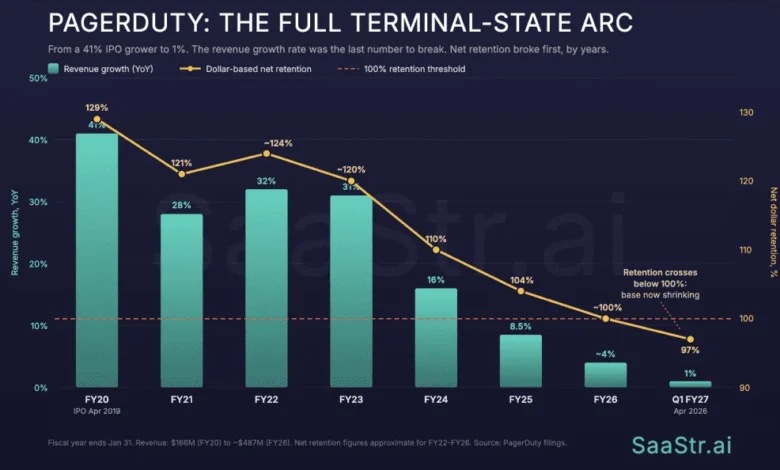
The global software-as-a-service (SaaS) industry is currently undergoing a fundamental structural shift that has effectively ended a twenty-year era of predictable, bond-like returns for mature business-to-business (B2B) enterprises. For two decades, the "slow lane" of the software sector was considered a safe haven for investors; even as growth rates decelerated into the mid-teens or single digits, these companies were prized for their high net revenue retention (NRR), robust margins, and the inherent stickiness of their contractual obligations. This stability transformed software stocks from high-risk growth vehicles into reliable annuities, attracting massive interest from private equity firms and institutional investors who viewed structured data trapped within proprietary applications as a permanent moat. However, as of mid-2026, market dynamics indicate that this "annuity" model is no longer functional, as a growing cohort of public software companies—including industry stalwarts like Dropbox, Zoom, DocuSign, and PagerDuty—struggle with growth rates under 5%, leading the market to question the very durability of their cash flows.
The Collapse of the B2B Safety Net
The traditional B2B software investment thesis relied on the assumption that once a platform was integrated into a corporate workflow, the cost of switching was prohibitively high. This created a "terminal value" that accounted for the vast majority of a company’s enterprise value. In a standard Discounted Cash Flow (DCF) model, between 85% and 95% of a software company’s valuation is derived from its projected earnings in the distant future. When a company is growing at 30% annually, investors focus on the immediate trajectory. However, when growth falls below the 5% threshold, the focus shifts entirely to the terminal value.
The current market correction suggests that the "automatic yes" regarding the durability of these annuities has been revoked. For the first time in the history of the sector, software companies are trading at multiples below the S&P 500 average. As of early 2026, the software industry is trading at approximately 22.7x forward earnings, trailing the broader market index. The iShares Expanded Tech-Software Sector ETF (IGV) has plummeted roughly 30% from its peak in September 2025, representing a staggering $2 trillion wipeout in market capitalization. This is not a temporary valuation dip driven by interest rates, but a fundamental re-evaluation of the risk profile of the software business model.
The Mechanism of Disruption: Agents Replacing Seats
The primary engine of the SaaS era was seat-based pricing. This model functioned on a simple correlation: as a customer’s business grew, their headcount increased, and their software spend rose in tandem. High NRR—often exceeding 110%—was the benchmark for success, fueled by the "land and expand" strategy. Artificial intelligence (AI) has introduced a "seat-eating" mechanism that attacks this engine directly.
AI agents are now capable of performing complex tasks previously reserved for human employees in departments such as customer support, IT service management (ITSM), and sales operations. When a single AI agent can perform the workload of ten human representatives, the customer no longer requires ten software seats; they require one human supervisor seat and a high-performance AI integration. This shift transforms expansion from a natural tailwind into a structural headwind. For companies like Dropbox, which has recently guided toward revenue declines, this reversal is becoming a visible reality. The budget that once flowed into CRM seats or additional storage tiers is being aggressively redirected toward AI infrastructure and agentic workflows.
Chronology of the Software Market Shift (2021–2026)
To understand the current crisis, one must examine the timeline of the industry’s transition from the "growth at all costs" era to the current "terminal value" skepticism:
- Late 2021: Software valuations reach all-time highs as the pandemic accelerates digital transformation. Companies trade at 20x to 30x revenue multiples.
- 2022–2023: Interest rate hikes force a shift toward profitability. The "Rule of 40" becomes the dominant metric, and companies begin aggressive cost-cutting and layoffs to preserve margins.
- 2024: Generative AI begins to move from experimental pilot programs to production. CIOs start questioning the long-term necessity of large-scale seat licenses for basic administrative tasks.
- 2025: The "Bifurcation" begins. Infrastructure companies see a resurgence in growth, while application-layer companies that rely on headcount growth start to stall. Anthropic and OpenAI see massive surges in enterprise revenue, signaling a shift in budget allocation.
- 2026 (Present): The market stops treating slow-growth software as a bond. The IGV falls below S&P 500 multiples, and the realization takes hold that many legacy SaaS platforms may be entering a period of permanent decline rather than a "graceful" plateau.
Data Analysis: The Great Bifurcation
The current market is no longer viewing "software" as a monolithic category. Instead, a clear divide has emerged between infrastructure providers that facilitate AI and applications that are being cannibalized by it.
The Infrastructure Re-acceleration
Companies providing the "picks and shovels" for the AI era are seeing their growth rates stabilize or even accelerate.

- Cloudflare: Recently guided to 28-29% growth, benefiting from the increased security and networking needs of AI-driven traffic.
- Snowflake: Reported 30% product growth as enterprises prioritize data readiness for large language models (LLMs).
- Twilio: Posted 20% growth, its highest in over three years, driven largely by AI-integrated voice and messaging workloads.
- DigitalOcean: Guiding toward 19-23% growth as small and medium-sized businesses seek accessible compute power for AI applications.
The Application Stagnation
Conversely, application-layer companies, particularly those in crowded categories or those reliant on simple file storage and document signatures, are hitting a wall.
- Dropbox and PagerDuty: Both are struggling to stay in positive growth territory, sitting at the bottom of the performance charts.
- HubSpot: Despite being a high-quality platform, HubSpot’s customer count growth has shown a consistent downward trend over five consecutive quarters, moving from 21% to 16%. This suggests that even market leaders are finding it harder to maintain the expansion rates of the previous decade.
The Massive Shift in Enterprise Spending
The redirection of capital is perhaps the most significant indicator of the "death of the annuity." Corporate budgets are finite, and the surge in AI spending is coming at the direct expense of traditional software expansion. Anthropic, a leader in the AI space, reportedly crossed a $19 billion annualized run rate in 2026, more than doubling its $9 billion figure from late 2025.
Furthermore, hyperscaler infrastructure spending—the capital expenditures of companies like Amazon (AWS), Microsoft (Azure), and Google Cloud—is projected to exceed $450 billion in 2026. Roughly 75% of this new spending is specifically targeted at AI hardware and services. This capital is being diverted from traditional enterprise IT budgets. CIOs are increasingly willing to "flatline" their spend on legacy CRM, ITSM, and ERP modules to free up the millions of dollars required to build and maintain AI-driven competitive advantages.
Implications for Private Equity and M&A
The change in how the market prices sub-5% growth has significant implications for the mergers and acquisitions (M&A) landscape. In the past, private equity firms would acquire slow-growing software companies at 5x to 8x revenue multiples, confident that the recurring revenue was safe for the next 15 years. They would optimize for cash flow, pay down debt, and enjoy a reliable internal rate of return (IRR).
In the current environment, the "safety" of that cash flow is under scrutiny. If the underlying data becomes more portable and AI agents can replicate the workflow of a legacy app in a matter of months, the 15-year horizon for that annuity disappears. This has led to a "valuation gap" where sellers still want prices based on the old annuity model, while buyers are pricing in the risk of a terminal decline. Consequently, the "graceful decline" that characterized B2B software for two decades is being replaced by a more volatile "cliff-edge" risk.
Fact-Based Analysis of the Future Landscape
The transformation of the software sector is not merely a cyclical downturn but a permanent re-architecting of how value is created and captured in the digital economy. The traditional "moat" of workflow lock-in is being breached by AI’s ability to interface with multiple data sources and automate across platforms.
For application-layer companies to survive this transition, they must move beyond seat-based pricing and adopt consumption-based or value-based models that align with the efficiency gains provided by AI. Simply "getting profitable" is no longer sufficient to sustain a high valuation. In a market where the terminal value is in doubt, profitability without a clear path to durable relevance is viewed as a liquidation strategy rather than a growth plan.
The broader impact on the tech ecosystem will likely involve a wave of consolidation. Legacy players with stagnant growth but high cash reserves may become "zombie" companies, focused solely on servicing their existing debt and maintaining a dwindling user base, or they may be absorbed by infrastructure giants looking to integrate vertical-specific data into their AI models. As the market cap of the software sector continues to diverge based on AI utility, the distinction between "software that feeds AI" and "software that AI feeds on" will become the primary metric for investor sentiment in the years to come.